Getting started with Truto
Install an integration, connect a Hubspot account, mint a link token from your backend, open the Truto Link UI from your frontend, and make your first Unified API call.
On Windows, install the CLI with PowerShell instead: irm https://cli.truto.one/install.ps1 | iex, then truto login --token $env:TRUTO_API_TOKEN.
Setting up Truto with a coding agent
If you're using Cursor, Claude Code, or any other agent that supports the Agent Skills convention, install the Truto skills pack and the Truto CLI once — the agent then knows how to wire Truto into your codebase from a single prompt.
1. Install the Truto skills pack
npx skills add trutohq/truto-skillsThis installs five skills your agent can call into:
| Skill | What it covers |
|---|---|
truto |
Application code that calls the Truto API — link-token routes, unified/proxy/custom calls, webhook handlers |
truto-link-sdk |
Embedding the Truto connection UI in a frontend with @truto/truto-link-sdk |
truto-cli |
Driving the Truto CLI for setup, exploration, and debugging in the terminal |
truto-jsonata |
Writing JSONata for unified-API mappings, sync jobs, workflows, RapidForms |
truto-api-conventions |
Truto API base URL, auth header, URL patterns, pagination, idempotency |
2. Install the Truto CLI
Linux / macOS:
curl -fsSL https://cli.truto.one/install.sh | bash
truto login --token "$TRUTO_API_TOKEN"
truto whoami -o json
Windows (PowerShell):
irm https://cli.truto.one/install.ps1 | iex
truto login --token $env:TRUTO_API_TOKEN
truto whoami -o json
The installer drops the truto binary in ~/.truto/bin (macOS/Linux) or %USERPROFILE%\.truto\bin (Windows). TRUTO_API_TOKEN is an API token created from the Truto Dashboard — see Generating an API token.
truto whoami -o json prints your team and environment. If you see your team name, the agent and the CLI are ready.
3. Prompts to drop into your agent
Once the skills and CLI are in place, paste any of these into your agent. Each one uses skills installed in step 1 and is enough on its own.
Set up Truto in this codebase. Add a POST /api/truto/link-token route on the
backend that mints a link token for a given tenantId, and a button in the
frontend that opens Truto Link with @truto/truto-link-sdk. Use the truto and
truto-link-sdk skills.
Add a webhook handler at POST /webhooks/truto. Switch on event_type. When we
receive integrated_account:active, mark the tenant's connection as ready and
store the integrated_account_id. Handle integrated_account:post_install_error
and integrated_account:validation_error too. Use the truto skill.Add a server-side helper that lists CRM contacts for a given
integrated_account_id by calling GET /unified/crm/contacts on api.truto.one,
then walks pages with next_cursor. Use the truto skill.Asking the docs with AI
The Truto Docs MCP server lets any AI assistant search and read these docs directly. No API key, no install — point your client at the endpoint and ask questions.
https://docs-mcp.truto.one/mcp
Pick your client below and add the config.
Claude Desktop
Claude Desktop connects to remote MCP servers through an npx bridge. Add this to your claude_desktop_config.json (Settings > Developer > Edit Config):
{
  "mcpServers": {
    "truto_docs": {
      "command": "npx",
      "args": ["-y", "mcp-remote", "https://docs-mcp.truto.one/mcp"]
    }
  }
}
Fully quit and reopen Claude Desktop after saving.
Cursor
Cursor supports remote MCP servers natively. Add this to .cursor/mcp.json in your project or ~/.cursor/mcp.json globally:
{
  "mcpServers": {
    "truto_docs": {
      "url": "https://docs-mcp.truto.one/mcp"
    }
  }
}
Claude Code
claude mcp add --transport http truto_docs https://docs-mcp.truto.one/mcpAdd --scope user to make it available across all projects.
VS Code + Copilot
Add this to .vscode/mcp.json in your workspace:
{
  "servers": {
    "truto_docs": {
      "type": "http",
      "url": "https://docs-mcp.truto.one/mcp"
    }
  }
}
Windsurf
Add this to ~/.codeium/windsurf/mcp_config.json:
{
  "mcpServers": {
    "truto_docs": {
      "serverUrl": "https://docs-mcp.truto.one/mcp"
    }
  }
}
Setting up Truto by hand
The rest of this page is the same flow without an agent — install integrations from the Dashboard, generate an API token, mint a link token from your backend, and call the unified API yourself. Use it as a step-by-step walkthrough on its own, or as a reference for what the agent prompts above are doing.
Install your first integration
Integrations are what enable you to connect your customer's apps to Truto.
Your Truto account by default doesn't come with any Integrations installed and any integration you need to use needs to be installed manually before connecting an account for it.
You can head on over to the Catalog to see the integrations available for installation under the Integrations tab.
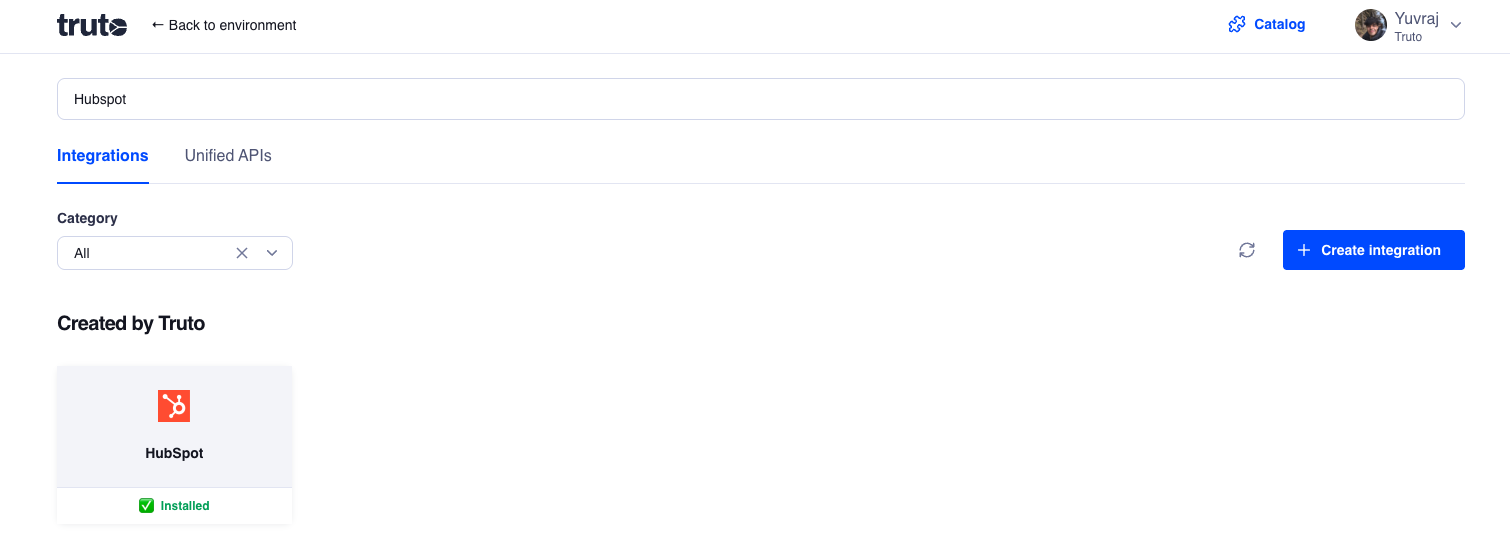
In this guide, we'll install the HubSpot integration. Find it in the Catalog and click Install.
Pick the environments you want it in and click Install.
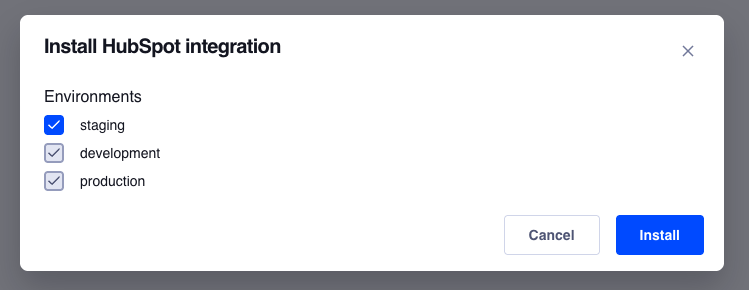
Environments are logical grouping of resources in your Truto account. They help you try out things in isolation without affecting your production data.
Install the Unified API for CRMs
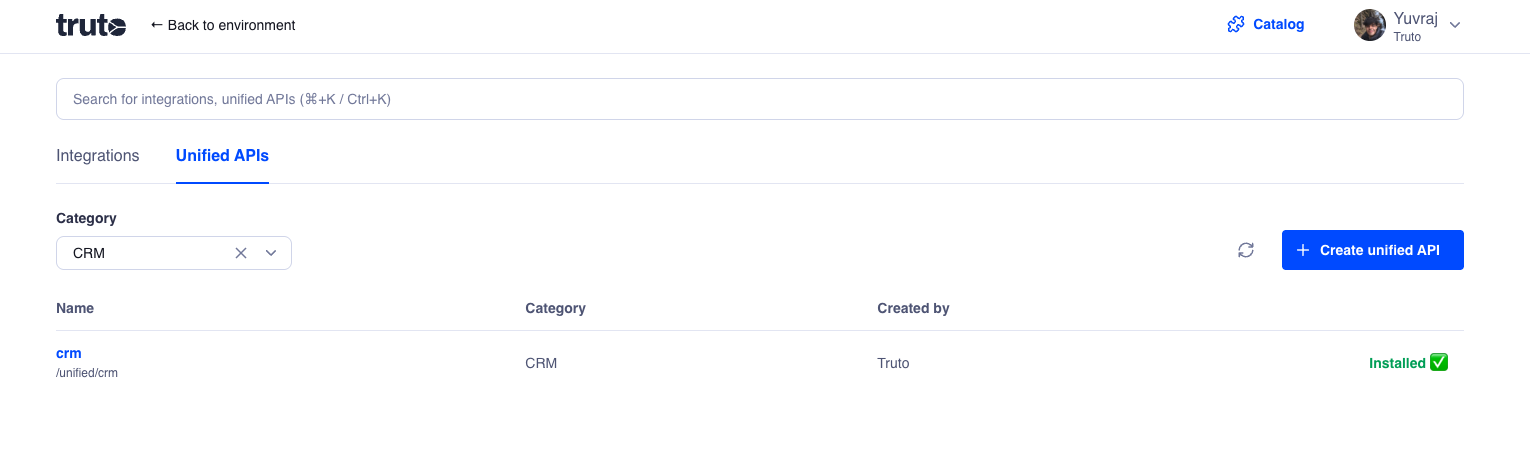
After installing Hubspot, we will install the Unified API for CRMs which will enable us to query the Hubspot API and get responses in a unified format. This Unified API can also be used with other CRMs.
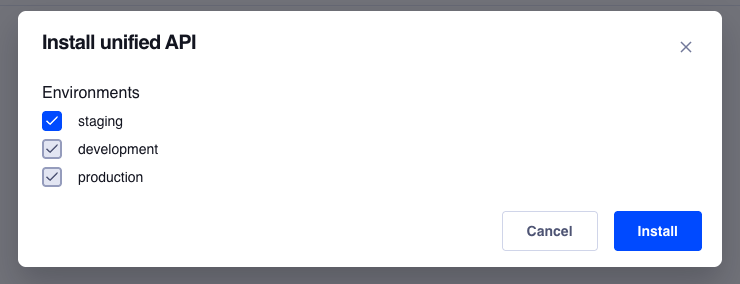
In the same Catalog, switch to the Unified APIs tab and install the crm Unified API. Installing a Unified API works the same way as installing an integration.
Generate an API token
You can follow our guide to generate an API token here.
Connect your first Hubspot account
Via the dashboard
Go to the Integrated accounts tab and click Connect Account in the top-right corner.

Fill in the Tenant ID — your own identifier for the customer this account belongs to, so you can match accounts back to them later. This creates (or reuses) a tenant in the environment; the same ID always refers to the same tenant, so every account this customer connects will roll up under it. Pick the Environment and Region, then click Get connection link.
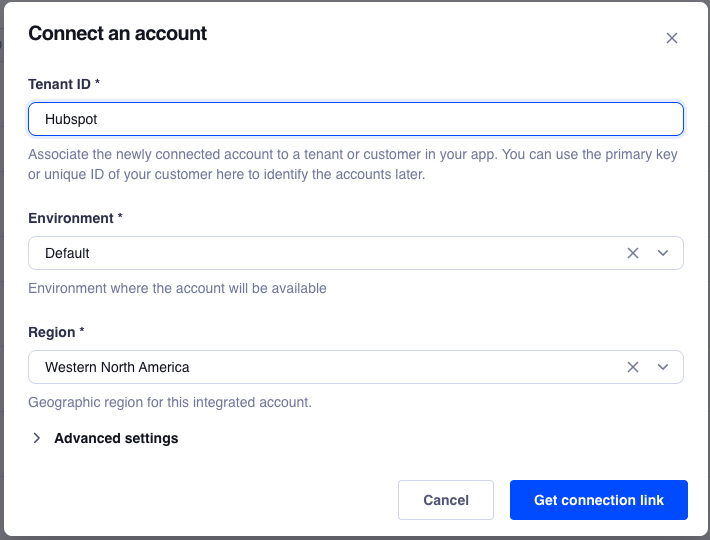
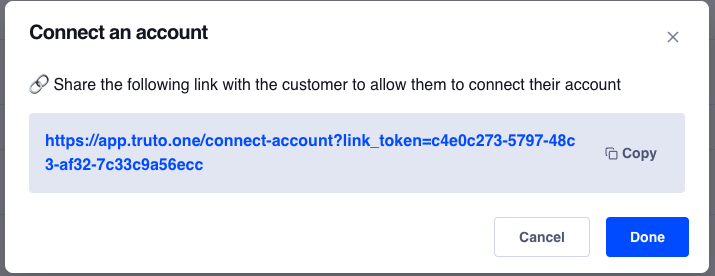
Truto returns a connection link. Copy it and open it yourself, or share it with the customer.
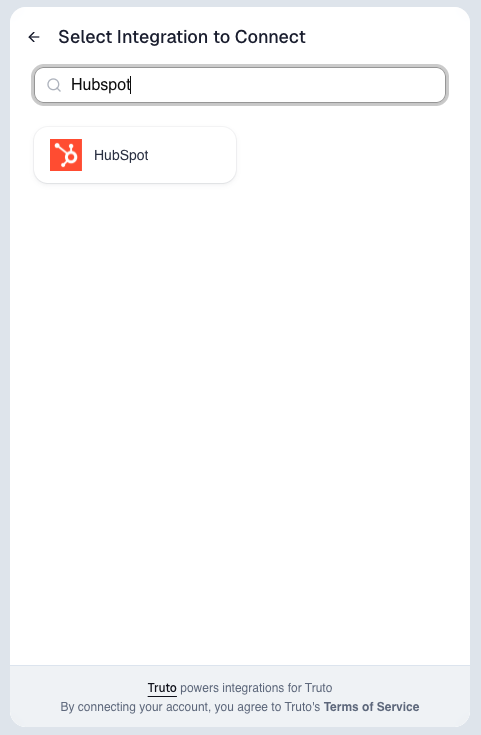
On that page, select HubSpot and complete the OAuth flow.
Back in the dashboard, click Done to close the modal. The new account now shows on the Integrated accounts tab.
From your own app
Connecting an account from your own app is two steps:
- Backend: mint a link token by
POSTing tohttps://api.truto.one/link-tokenwith your API token. - Frontend: open the Truto Link UI with
@truto/truto-link-sdkand that link token.
Step 1. Mint a link token from your backend
TRUTO_API_TOKEN is a server-side secret. Read it from an env var; never ship it to the browser. The same route handles new connections (tenant_id) and reconnections (integrated_account_id) — wiring both from the start prevents users from creating duplicate accounts when an existing connection fails.
Truto auto-creates a tenant the first time a given tenant_id connects an account. If you'd rather pre-create the tenant (to attach metadata like tier or region before the customer connects), call POST /tenant first — see Creating tenants.
// npm install @truto/truto-ts-sdk
import TrutoApi from '@truto/truto-ts-sdk';

const truto = new TrutoApi({
  token: process.env.TRUTO_API_TOKEN!,
});

// New connection
const { link_token } = await truto.linkToken.createForNewIntegration({
  tenant_id: 'acme-1',
});

// Reconnect an existing account
const reconnect = await truto.linkToken.createForExistingIntegratedAccount({
  integrated_account_id: 'existing-account-id',
});
# pip install truto-python-sdk
import asyncio, os
from truto_python_sdk import TrutoApi
async def main():
truto = TrutoApi(token=os.environ["TRUTO_API_TOKEN"])
# New connection
new_token = await truto.link_tokens.create({"tenant_id": "acme-1"})
# Reconnect an existing account
reconnect_token = await truto.link_tokens.create({
"integrated_account_id": "existing-account-id",
"persist_previous_context": True,
})
print(new_token, reconnect_token)
asyncio.run(main())curl --location 'https://api.truto.one/link-token' \
--header 'Content-Type: application/json' \
--header "Authorization: Bearer $TRUTO_API_TOKEN" \
--data '{
"tenant_id": "acme-1"
}'import express from 'express';
const app = express();
app.use(express.json());
app.post('/api/truto/link-token', async (req, res) => {
const { tenantId, integratedAccountId } = req.body;
const body = integratedAccountId
? { integrated_account_id: integratedAccountId, persist_previous_context: true }
: { tenant_id: tenantId };
const response = await fetch('https://api.truto.one/link-token', {
method: 'POST',
headers: {
Authorization: `Bearer ${process.env.TRUTO_API_TOKEN}`,
'Content-Type': 'application/json',
},
body: JSON.stringify(body),
});
const { link_token } = await response.json();
res.json({ linkToken: link_token });
});// app/api/truto/link-token/route.ts
export async function POST(req: Request) {
const { tenantId, integratedAccountId } = await req.json();
const body = integratedAccountId
? { integrated_account_id: integratedAccountId, persist_previous_context: true }
: { tenant_id: tenantId };
const response = await fetch('https://api.truto.one/link-token', {
method: 'POST',
headers: {
Authorization: `Bearer ${process.env.TRUTO_API_TOKEN}`,
'Content-Type': 'application/json',
},
body: JSON.stringify(body),
});
const { link_token } = await response.json();
return Response.json({ linkToken: link_token });
}import { Hono } from 'hono';
type Env = { TRUTO_API_TOKEN: string };
const app = new Hono<{ Bindings: Env }>();
app.post('/api/truto/link-token', async (c) => {
const { tenantId, integratedAccountId } = await c.req.json();
const body = integratedAccountId
? { integrated_account_id: integratedAccountId, persist_previous_context: true }
: { tenant_id: tenantId };
const response = await fetch('https://api.truto.one/link-token', {
method: 'POST',
headers: {
Authorization: `Bearer ${c.env.TRUTO_API_TOKEN}`,
'Content-Type': 'application/json',
},
body: JSON.stringify(body),
});
const { link_token } = await response.json();
return c.json({ linkToken: link_token });
});
export default app;import os
import requests
from flask import Flask, request, jsonify
app = Flask(__name__)
@app.post("/api/truto/link-token")
def link_token():
payload = request.get_json() or {}
tenant_id = payload.get("tenantId")
integrated_account_id = payload.get("integratedAccountId")
body = (
{"integrated_account_id": integrated_account_id, "persist_previous_context": True}
if integrated_account_id
else {"tenant_id": tenant_id}
)
response = requests.post(
"https://api.truto.one/link-token",
headers={
"Authorization": f"Bearer {os.environ['TRUTO_API_TOKEN']}",
"Content-Type": "application/json",
},
json=body,
timeout=10,
)
response.raise_for_status()
return jsonify(linkToken=response.json()["link_token"])Response:
{
  "link_token": "e73c7b9b-2e4d-47d1-b5d2-83441fd24e4c"
}TRUTO_API_TOKEN must stay on the server. Never expose it to the browser, and never hardcode it in client bundles. Link tokens are short-lived, single-use credentials safe for the frontend; the API token isn't.
Step 2. Open Truto Link from your frontend
Install the SDK:
npm install @truto/truto-link-sdkCall your backend route to get a link token, then hand it to authenticate(). The same call works for new connections and reconnections — the difference is in the body your backend posts.
import authenticate from '@truto/truto-link-sdk';

async function getLinkToken(body: Record<string, string>) {
  const res = await fetch('/api/truto/link-token', {
    method: 'POST',
    headers: { 'Content-Type': 'application/json' },
    body: JSON.stringify(body),
  });
  const { linkToken } = await res.json();
  return linkToken;
}

async function openTrutoLink(linkToken: string) {
  try {
    const result = await authenticate(linkToken);
    console.log('Connected:', result);
    // { result: 'success', integration: 'hubspot', integrated_account_id: '...' }
    return result;
  } catch (err) {
    if (err === 'closed') {
      console.log('User closed the connection dialog');
    } else {
      console.error('Connection failed:', err);
    }
    throw err;
  }
}

// New connection
const linkToken = await getLinkToken({ tenantId: 'acme-1' });
await openTrutoLink(linkToken);

// Reconnect an existing account
const reconnectToken = await getLinkToken({ integratedAccountId: 'existing-account-id' });
await openTrutoLink(reconnectToken);
If you'd rather not embed the SDK, you can hand the link token to Truto's hosted connection page directly:
https://app.truto.one/connect-account?link_token=<link-token-from-previous-step>See Embedding the Truto Link SDK for popup, iframe, and same-window options, and the full request schema for POST /link-token.
Make your first API request
Open the newly connected HubSpot account's detail page and switch to the Unified API tab. This opens a playground where you can pick a resource (like crm/contacts) and method, call the API, and see the unified response — a quick way to try calls before wiring them into your code.
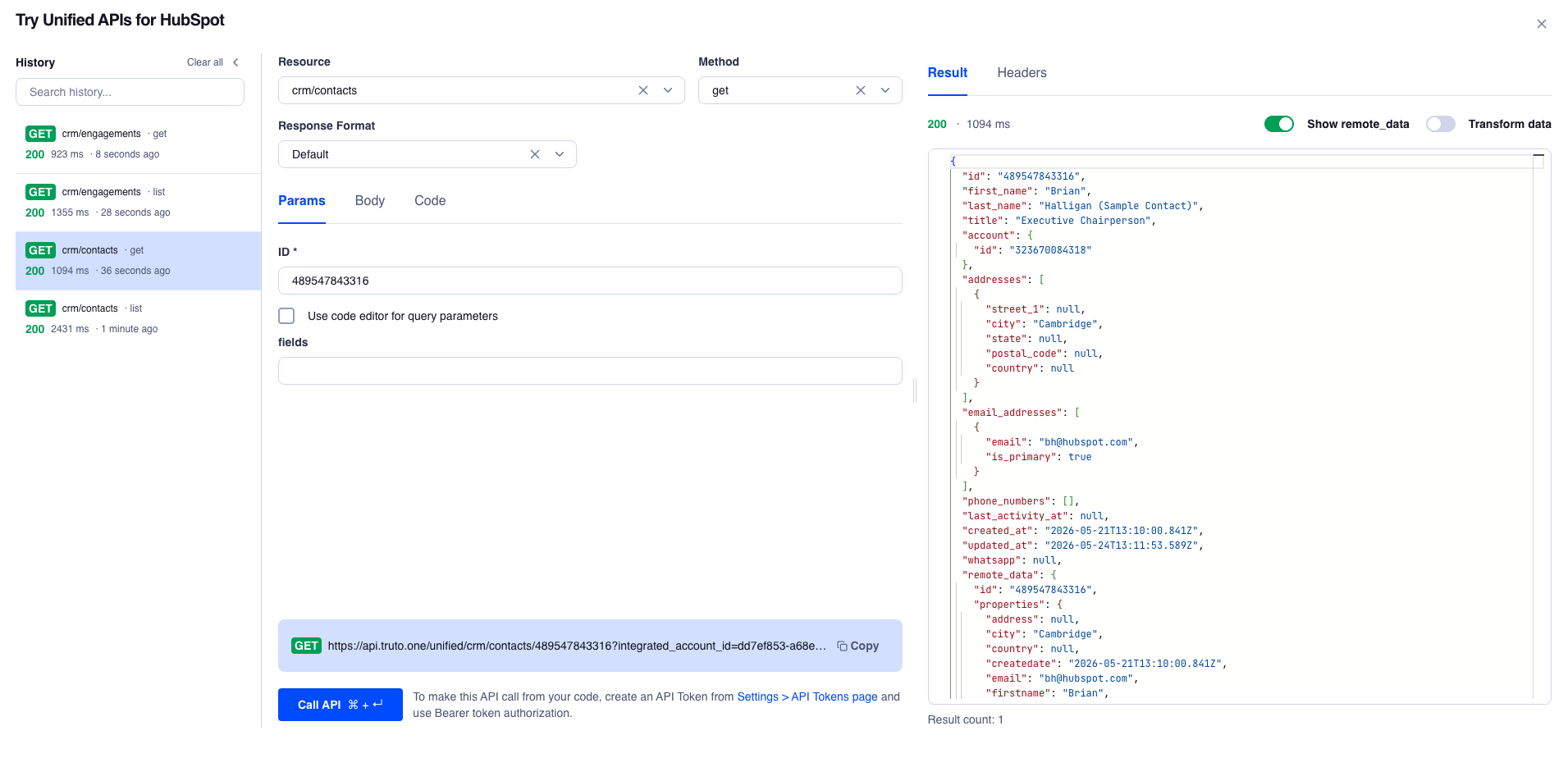
To make the same call from your code, use your API token in the Authorization: Bearer header. The API reference page for the CRM Unified API lists every available resource and method.
API Reference
To know more about how our APIs work, you can checkout our API Reference.